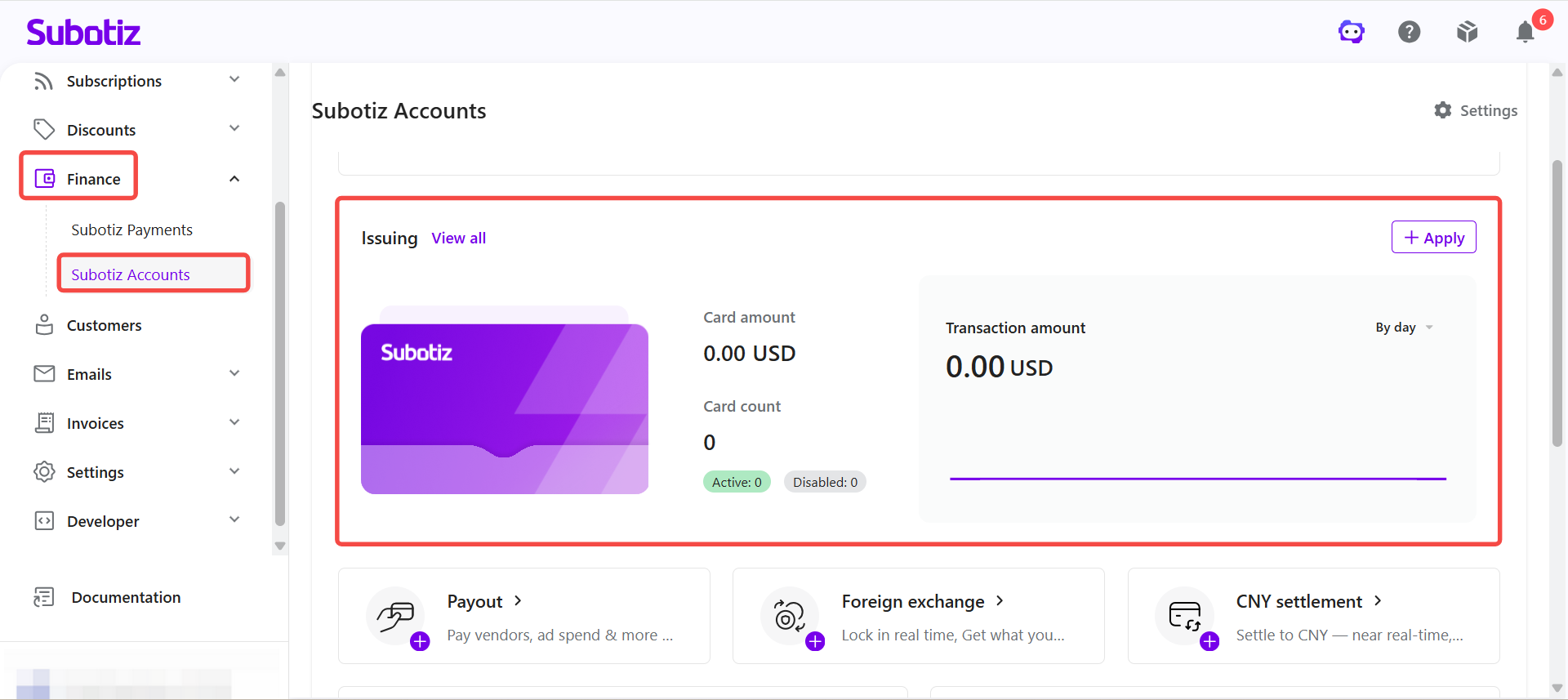
Issuing VCC in Subotiz Accounts allows merchants to issue and manage virtual credit cards for expenses such as advertising, SaaS subscriptions, AI tools, cloud services, and procurement. Merchants can use Regular Cards or Shared Cards based on how they want to fund and manage spending.
Virtual Credit Cards
A virtual credit card (VCC) is designed for online payments and does not require a physical card. Each virtual card has its own card number, expiration date, and CVV for completing online transactions.
Merchants can create separate virtual cards for different business expenses instead of using the same card across multiple payment scenarios. This makes it easier to separate budgets, track spending, and manage card usage.
Virtual credit cards can be used for business expenses such as:
- Advertising on platforms such as Meta, Google, and TikTok
- SaaS subscriptions
- AI tool subscriptions
- Cloud services
- Procurement
- E-commerce operations
- Other online business payments
Using separate cards for different business purposes helps merchants organize expenses, track spending more accurately, and simplify reconciliation.
Card Types
Issuing VCC provides two card types: Regular Cards and Shared Cards. The main difference is how funds are managed.
- Regular Card: A Regular Card has its own balance. Funds are added directly to the card, and transactions are deducted from that card's available balance.
- Individual advertising accounts
- SaaS subscriptions
- Payments to individual vendors
- Project-specific budgets
- Separate balance for each card
- Independent funding and spending control
- Suitable for separating expenses by business purpose
- Shared Card: A Shared Card draws funds from an Issuing Account shared by multiple cards. Transactions are deducted from the Issuing Account rather than from an individual card balance, so merchants do not need to fund each Shared Card separately.
- Multiple advertising accounts
- Multiple cardholders
- Multiple payment purposes
- Centralized management of multiple virtual cards
- Multiple cards draw from the same Issuing Account
- No individual card top-ups required
- Per-transaction, daily, and monthly spending limits
- Centralized fund management
Feature Benefits
- Centralize business payments: Manage virtual credit cards from one place in Subotiz Accounts.
- Separate business expenses: Use different cards for advertising, subscriptions, vendors, teams, or other business purposes.
- Control card spending: Manage funds at the individual card level with Regular Cards or use spending limits with Shared Cards.
- Track transactions: Review authorization transactions, settlement transactions, card records, and fund records from the Transaction page.
- Manage cards online: Apply for and manage virtual cards directly from Subotiz Accounts.
Specifications
Item | Details |
|---|---|
Card network | Mastercard |
Card types | Regular Card, Shared Card |
Issuing regions | Hong Kong: Regular Card and Shared Card; United States: Shared Card only |
Supported currency | USD |
Card validity | 3 years |
Application method | Online application |
Usage | Online payments worldwide |
Use cases | Advertising, SaaS, AI tools, cloud services, procurement, and other online payments |
Notes
Issuing VCC helps merchants manage virtual cards, business payments, and spending from Subotiz Accounts. Regular Cards provide separate card balances, while Shared Cards draw from a centralized Issuing Account with configurable spending limits.