In Subotiz, Product taxable type identifies the tax category of a product or service and helps the system determine the appropriate tax treatment when tax calculation is required. Merchants should select the product taxable type that best reflects what they sell to support accurate tax treatment and consistent product management.
Note: Applicable taxes and tax rates depend on the nature of the product or service, the transaction location, and local tax regulations. The product taxable type descriptions in this article do not constitute tax advice.
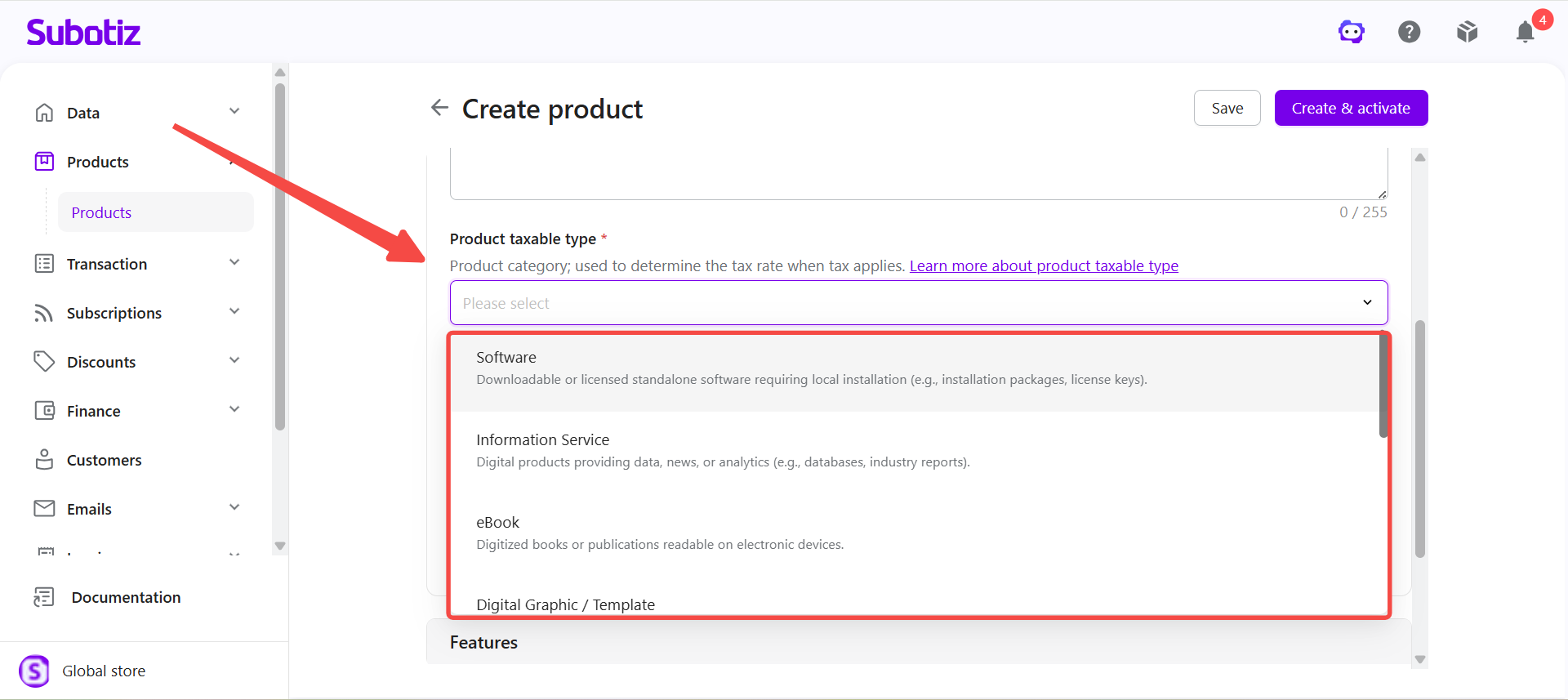
Supported Product Types
- Software as a Service (SaaS)
- Definition: Subscription-based software delivered online without local installation.
- Key characteristics:
- Cloud-hosted, multi-tenant structure with on-demand access.
- Billed monthly or annually through recurring subscriptions.
- Maintenance, updates, and security handled by the vendor.
- Tax consideration: Typically treated as a digital or cloud service and may be subject to VAT or GST.
- Examples: Salesforce (CRM SaaS), Zoom (video conferencing).
- Software
- Definition: Downloadable or licensed software installed on a user's device.
- Key characteristics:
- One-time purchase or perpetual license.
- May include optional maintenance or upgrade services.
- Tax consideration: Generally classified as a software sale and often subject to copyright-related tax rules.
- Examples: Adobe Photoshop, AutoCAD, and locally installed AI software.
- Online Video Content
- Definition: Digital video content offered via streaming or download, including courses, films, and live broadcasts.
- Key characteristics:
- Available through subscription (SVOD) or pay-per-view (PVOD) models.
- Involves content licensing and usage rights.
- Tax consideration: Categorized as digital content services; entertainment or copyright taxes may apply in some regions.
- Examples: Netflix, MasterClass.
- Information Service
- Definition: Digital services that provide data, reports, or analysis.
- Key characteristics:
- Frequently updated, with an emphasis on accuracy and timeliness.
- May be delivered through API access or subscriptions.
- Tax consideration: Generally treated as an information service, with tax rates varying by content type.
- Examples: Bloomberg Terminal, Statista (data platform).
- eBook
- Definition: Electronic books or publications that can be read on digital devices.
- Key characteristics:
- Common formats include PDF and EPUB, often with DRM protection.
- Includes novels, textbooks, and academic publications.
- Tax consideration: Some regions apply the same reduced tax rates to eBooks as to printed books.
- Examples: Kindle eBooks, WeChat Read.
- Digital Graphic or Template
- Definition: Downloadable design assets such as PowerPoint, PSD, or marketing templates.
- Key characteristics:
- Licensing terms for personal or commercial use must be clearly defined.
- Commonly used in design, marketing, and creative fields.
- Tax consideration: Generally treated as the sale of digital goods and may be subject to taxes related to design copyrights.
- Examples: Canva (template library), Envato Elements (design asset library).
- Video Game
- Definition: Interactive software including downloadable games, downloadable content (DLC), or virtual currency.
- Key characteristics:
- Includes base games, expansion packs, and in-game purchases.
- Supports use across multiple platforms or devices.
- Tax consideration: Some regions impose digital entertainment taxes on games or in-game purchases.
- Examples: Genshin Impact, Steam.
- Blockchain Digital Products
- Definition: Unique digital assets recorded on a blockchain, such as NFTs or virtual land.
- Key characteristics:
- Ownership is verified through smart contracts.
- May generate royalties from secondary-market transactions.
- Tax consideration: This is an emerging category. Blockchain digital products may be treated as digital assets and subject to capital gains tax in some regions.
- Examples: Bored Ape Yacht Club (NFT collection), Decentraland (virtual real estate).
- Other Digital Products
- Definition: Digital goods not covered by the categories above, such as digital tickets or audio services.
- Key characteristics:
- Requires clear licensing terms and a clearly defined scope of use.
- Supports a variety of pricing models and classification rules.
- Tax consideration: Different tax rules may apply depending on the business model.
- Examples: Spotify (music streaming), Eventbrite (digital ticketing).
Best Practices
- Select the most appropriate product type: Choose the product type that best reflects the nature of the product or service you sell.
- Differentiate between similar product types: If a product has characteristics of multiple digital product types, select the type that best represents its primary offering and delivery method.
- Confirm applicable tax requirements: Tax treatment for digital products and services varies by country and region. Confirm the requirements that apply to your business and target markets.
Selecting the appropriate product type helps the system apply the relevant tax classification based on the nature of the product or service. Consistent classification also supports accurate product management and tax treatment across your Subotiz product catalog.